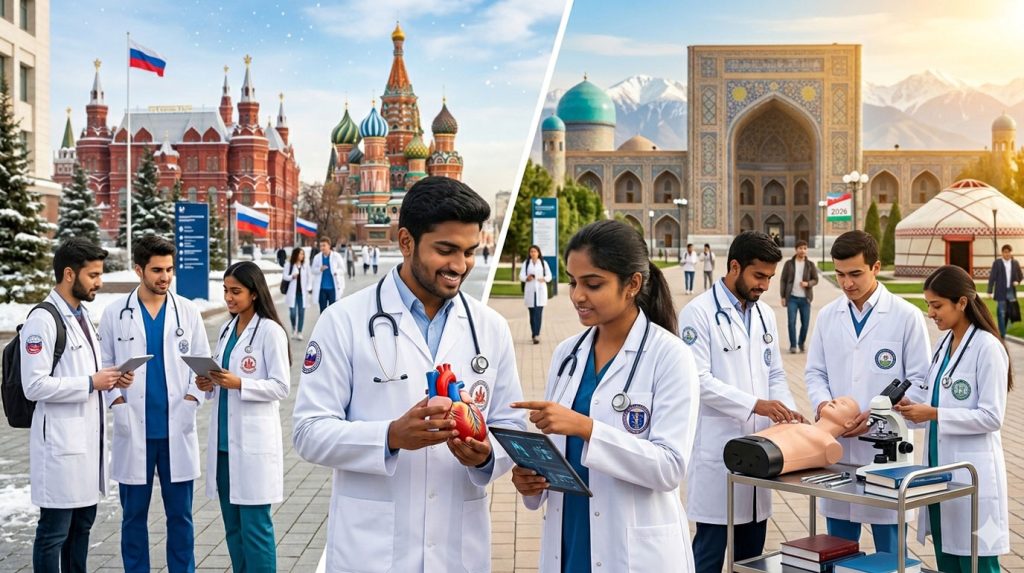
Every year, more than two million students sit for NEET, but government medical college seats in India number under one lakh. That gap has made MBBS in Russia for Indians one of the more established study-abroad options, with a track record going back decades.
Russia has offered medical education to Indian students for a long time, and today more than 40 of its state medical universities admit international students into programmes recognised by India’s National Medical Commission (NMC). The course is usually called “General Medicine” locally and runs for six years: five years of classroom and laboratory work, followed by a one-year clinical internship.
Eligibility for Indians
To apply, a student must have completed Class 12 with Physics, Chemistry and Biology, scoring at least 50% overall (40% for reserved categories), and must hold a valid NEET qualifying score. Most Russian universities do not hold a separate entrance test; admission is based on these documents plus an invitation letter from the chosen university. Applicants must also be at least 17 years old by 31 December of their admission year.
Recognition and the licensing exam
Recognition is the single most important thing to check before choosing a university. Confirm that it is listed in the WHO’s World Directory of Medical Schools (WDOMS) and appears on the NMC’s list of approved foreign institutions. This listing is what allows a graduate to sit for the Foreign Medical Graduate Examination (FMGE), the screening test every Indian citizen who studies medicine abroad must clear before registering to practise in India. A National Exit Test (NExT) is expected to eventually replace the FMGE, but as of 2026 no confirmed date has been set for foreign graduates, so the FMGE remains the exam to prepare for.
What it costs
Tuition fees for MBBS in Russia vary by university and city but generally fall between ₹3 lakh and ₹6 lakh a year, with many well-established government universities closer to the ₹3.5-4 lakh mark. Add hostel fees, food, insurance and visa costs, and the total for all six years usually comes to somewhere between ₹20 lakh and ₹30 lakh — still well below what most private medical colleges in India charge.
Language and daily life
Classes for international students are conducted in English, though most universities include Russian language lessons, since clinical rotations from the third year onward involve interacting with local patients. Russian university towns that host large numbers of Indian students typically have Indian messes, grocery stores and student associations, which makes the transition easier.
A note on safety
Some parents understandably ask about safety given the ongoing Russia-Ukraine conflict. The universities most commonly chosen by Indian students — in cities such as Yaroslavl, Arkhangelsk, Kazan, Tver and Voronezh — sit well away from the border regions affected by the conflict, and academic life there has continued largely as normal. Even so, families should check the latest advisories from the Indian Embassy in Moscow before finalising travel.
Before you decide
Because Russia has so many NMC-approved universities, quality does vary between them. Prospective students should ask for a university’s recent FMGE pass percentage, verify its WDOMS listing directly on the WHO website, and speak to current Indian students if possible, rather than relying only on what an agent or brochure claims.