
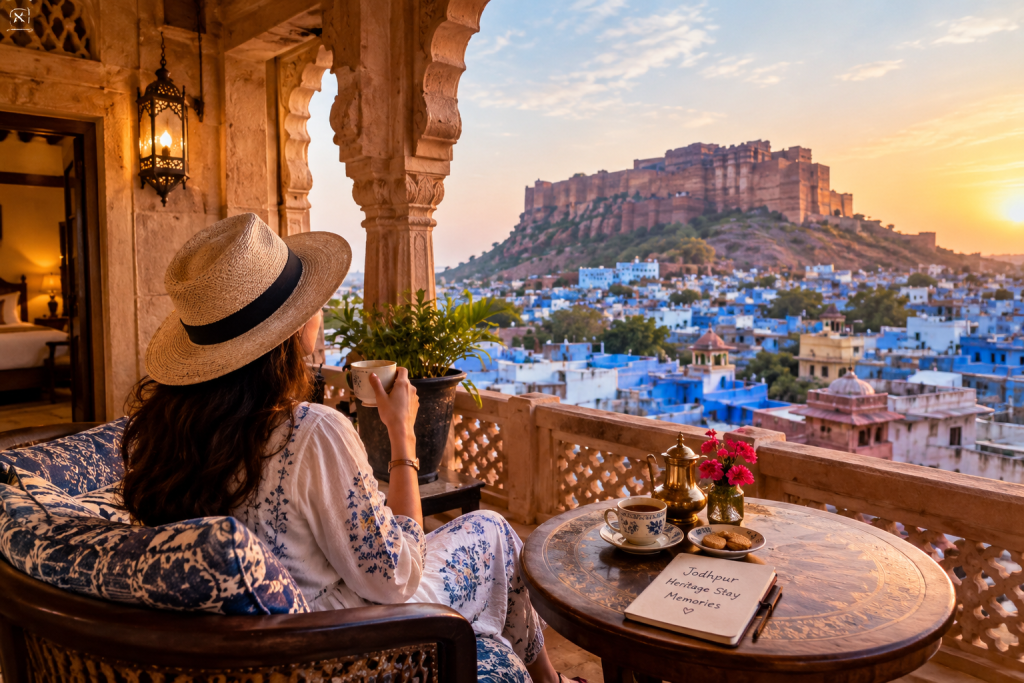
Most travel enthusiasts view Jodhpur from the window of their cars. They visit the fort and get some spices before leaving. I decided to stay in the old town instead. I booked a heritage stay in a restored palace with intricate balconies and a serene courtyard. After three nights, I realised how it transformed my perspective on the Blue City. I woke up to the sound of temple bells, had breakfast under ancient arches, and walked home through narrow streets.
Why a heritage stay suits Jodhpur
A heritage property refers to an old villa or palace where tourists can stay. Jodhpur has many such places located inside the walls of the old town. I have stayed in modern hotels before, but for this trip I wanted something different, a place with its own story to tell. The old city is also suitable for the exploration of markets, forts, and other interesting places on foot.
Arriving at the haveli in old Jodhpur
A haveli is an old-fashioned courtyard home, which is a residence for affluent merchant families. My driver parked the vehicle next to the bylanes, and I walked a few meters. When I reached the door, the thick wooden door opened to the main courtyard made of stone and a water fountain. One staff member gave me some cold mint water. The thick bricks blocked the noise coming from the street.
Waking up to Jodhpur’s Mehrangarh Fort
Mehrangarh Fort is one of Jodhpur’s well-known attractions. It was established by Rao Jodha during 1459, located on top of the Jodhpur city. When I reached the roof of the haveli, I saw the image of Mehrangarh Fort shining in the sun. I drank tea while observing the changing colours.
Breakfast under the arches in Jodhpur
Heritage hotels usually serve meals for their guests either in courtyards or on terraces. In my case, Breakfast was served under stone arches. I had poha, fruits, and hot parathas with curd. A cook told me that many of the dishes came from the family of the owner of the hotel. The food was simple and hot.
Walking the blue lanes of Jodhpur
The multitude of blue houses in Jodhpur has popularised the city’s nickname. While some believe this hue distinguished the houses of Brahmins, others think of it as a way of keeping houses cool during hot summers. I walked through those streets without any plan whatsoever. Children played cricket beside the blue walls, and shopkeepers kept sweeping the ground at their front.
Rooftop evenings in Jodhpur
The rooftops are a hidden gem of Indian ancient cities. My haveli had a terrace where I could sit on soft lamps and cushions. Each evening I went there with a glass of lassi. I would stare at the fort brilliantly illuminated against the deep, dark sky.
Simple vegetarian meals in Jodhpur
Jodhpur food is rich, spicy and filling. I tried mirchi vada, a fried chilli fritter, from a street stall. Onion kachori and mawa kachori came from busy sweet shops. At the haveli, I ate dal baati churma in the courtyard. Everything was vegetarian, warm and generous. The makhaniya lassi nearly became a daily habit.
What I would tell anyone booking a heritage stay in Jodhpur
Reserve in advance as good accommodations fill up quickly. When packing, avoid heavy luggage because the streets of Jodhpur are narrow. Don’t forget about a shawl either, as the thick walls keep the rooms cool at night. In my case, business class flights were a good decision as the seat turned out very comfortable and offered sufficient legroom, and the service during the flight was remarkable. It is also worth mentioning that I could use priority services at the airport, which made the whole travel experience much easier.
Final thoughts
Basically, what I got from the journey to Jodhpur was not only visiting a fort but also the experience of reminiscing about the courtyard, a silent stairway and a rooftop garden at sunset. Staying at a heritage accommodation made it so much simpler. I did not hurry from one sight to another. I allowed the old city to come to me. It may become the part you remember longest.